
Part 1
Track Stars – Part 1
Releases September 27, 2026
Prologue: The Starting Line
At eight o’clock on Monday morning, a countdown interrupted conversations across the Caribbean.
00:00:05
In a school courtyard, six students crowded around a phone held above someone’s breakfast. Inside an electronics store, an employee switched the display televisions to the livestream and abandoned the remote beside the till.
00:00:03
A bus crawled through Nassau traffic. Near the back, a passenger turned up his phone. The person beside him leaned closer.
00:00:01
An engine snarled through the speakers.
A car shot down a Nassau street, close enough to passing traffic for its wing mirror to skim a delivery van. Electric-blue nitro flared behind it. Storefronts blurred, the road bent sharply, and the driver threw the car sideways beneath a hanging sign.
The footage cut to Andros.
Tyres left a broken bridge. For a moment, the car hung above green mangroves with nothing beneath its wheels. Then it landed on a muddy shortcut, suspension compressing as brown water swept across the windscreen.
In Grand Bahama, rain shone on stacked shipping containers. Two racers entered the same narrow gap. One braked. The other clipped a steel barrier and lost enough speed for its rival to take the lead.
The next cut opened onto Exuma: white sand, shallow water and a road following the turquoise coast. A car burst out of the surf, found the asphalt and accelerated toward a finish banner.
The engine note climbed.
The screen went black.
TRACK STARS
At Coral Harbour Academy, applause broke out halfway down the assembly hall.
“Quiet, please,” a teacher called.
Someone near the back made an engine noise.
The teacher turned. Several students became unusually interested in their shoes.
On the screen above the stage, the title gave way to a launch event. Racing simulators stood beneath bright lights, with cameras positioned to catch the players’ faces and the action on their monitors.
The Caribbean studio behind Track Stars had finished showing what its first major game could do.
An eCarib representative stepped up to the microphone to explain what players could do with it.
“Today, we’re opening registration for the Track Stars School League.”
At the front of the assembly hall, Dario Bethel sat straighter.
“Secondary-school clubs from across the region will compete in a seasonal championship, with four drivers racing against four.”
A demonstration appeared behind the presenter. Eight cars waited on a grid, divided into two team colours.
“Each finishing position earns points. Your team’s combined score decides the result.”
The footage advanced. One driver crossed the line first and raised both hands. Three opposing cars finished close behind.
When the totals appeared, the celebrating driver lowered his arms.
A ripple of laughter moved through the hall.
Beside Dario, Zahra Bain leaned forward.
“Still came first,” she whispered.
Dario kept watching.
The presenter continued through league registration, school eligibility and the competition calendar. Students began shifting in their seats. One teacher glanced at the clock.
Then a new heading appeared.
CARIBBEAN SCHOLARSHIP GRAND PRIX
The hall settled.
“This December, the highest-performing eligible student drivers will be invited to compete for full and partial university scholarships.”
Rochelle Burrows reached for the phone in her bag.
Around her, other students were doing the same.
On the livestream, comments climbed past too quickly to follow. Questions about consoles and controllers disappeared beneath questions about age requirements, participating schools and how much the scholarships would cover.
The presenter was still speaking when the first club messages arrived.
We need four.
We need permission first.
Ask now.
At Coral Harbour Academy, the broadcast ended and the school crest returned to the screen. Beneath it appeared a Wild Hog wearing racing goggles.
CORAL HARBOUR ACADEMY WILD HOGS ESPORTS CLUB
DRIVER TRIALS COMING SOON
This time, the teacher waited for the noise to subside.
Dario was already writing something down. Zahra tried to read over his shoulder.
“Tell me that’s the signup list.”
“Equipment.”
“We have equipment.”
“We’re going to need more.”
Across the hall, students began choosing teammates before anyone had explained how selection would work. Friends claimed seats for one another in imaginary cars. Rivals compared experience. Someone who had never touched a racing wheel announced that it could not be much harder than driving a real one.
For most of them, the first question was which car to choose.
Amara Rolle would come to the game with a different question.
Would the scholarship arrive before January fifteenth?

Chapter One: January Fifteenth
The university acceptance letter had arrived on the third of August.
For eleven days, it had been the most important thing in Amara Rolle’s life.
Her mother had cried before reaching the second paragraph. Kellan had lifted Amara off the kitchen floor and spun her around until she threatened to kick him.
“An engineer,” he kept saying.
“If you drop me, you’ll have to wait for another one.”
That evening, he brought home guava duff from the bakery near the garage. Her mother insisted on proper plates. Kellan ate his standing at the counter, reading the letter again with one hand while Amara watched for custard near the paper.
She had applied in May, after years of making sure she would have something worth putting on the application. Her national examinations were already behind her, completed in Grade Eleven. Senior year would mean finishing school, preparing to leave and working through the reading list she had started before the university sent one.
Then her mother became ill.
Hospital fees took the first portion of the education fund. Tests took more. Medication and follow-up appointments became expenses that had to be paid again, even after everyone had agreed they could barely afford them the first time.
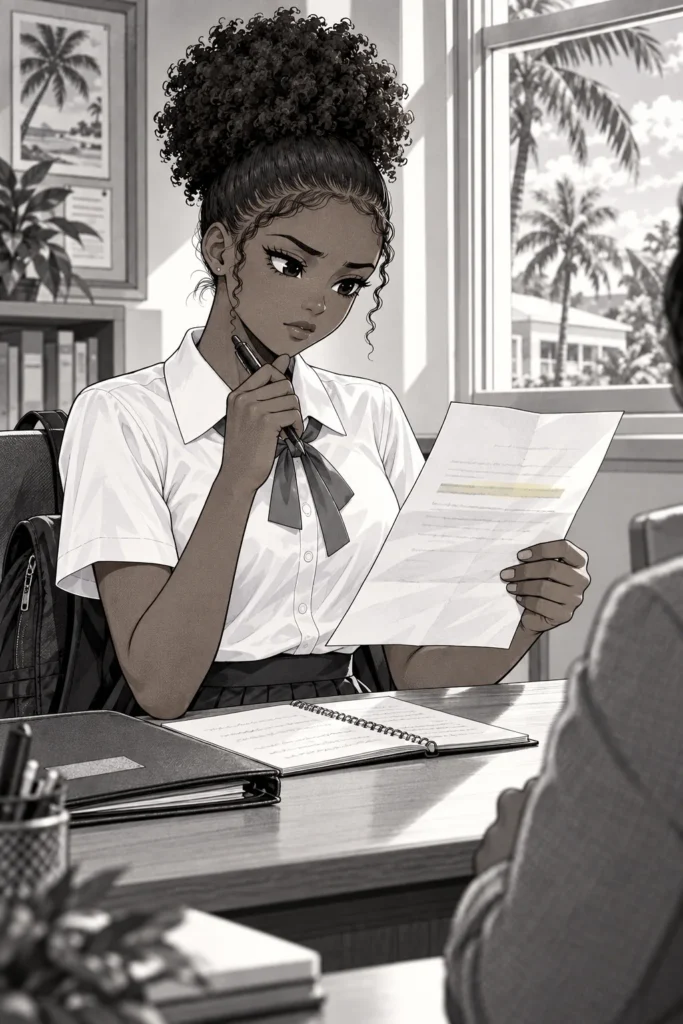
By the time Amara sat down in the guidance office at Coral Harbour Academy, the acceptance letter had acquired a soft crease across its middle.
The university’s requirements had not changed.
“Proof of financial support by January fifteenth,” Mrs Knowles said, reading the paragraph marked in yellow.
“I know.”
“That’s different from paying the tuition. They need evidence that your first academic year will be covered.”
“We don’t have that either.”
Mrs Knowles set the letter on her desk.
The air-conditioning blew steadily against Amara’s knees. She smoothed her navy skirt beneath her palms and looked past the counsellor at a poster of a road disappearing into a golden sunrise.
Dream it. Plan it. Achieve it.
She had done the first two. Apparently there should have been something between planning and achieving about keeping an emergency fund separate from the emergency fund.
“Your mother mentioned savings at our last parent meeting,” Mrs Knowles said.
“Most of it went toward her treatment.”
“How is she doing?”
“She’s home.”
“That must be a relief.”
“Yes.”
Amara caught the loose curl beside her cheek and tucked it back. It slipped free almost immediately.
Being home meant her mother could complain about the television volume and ask whether anyone intended to water the plants. It also meant Amara could hear her coughing from the next room. Some evenings she seemed almost herself. Other evenings the soup went cold before she finished it.
Mrs Knowles waited.
“She still needs medication,” Amara added. “And more appointments. We can’t count the money that’s left as university money.”
“No. You can’t.”
“My brother is working extra shifts.”
“Kellan?”
Amara nodded.
Mrs Knowles remembered him. Most teachers who had owned unreliable cars while he was a student remembered him.
“Still at Bain’s Auto Works?”
“Yes.”
“And your father?”
“He isn’t involved.”
The counsellor accepted that without asking Amara to explain it. She turned toward her computer.
“Mechanical engineering is still the plan?”
“Yes.”
“Kellan must be pleased.”
“He says I’m going further than him.”
She looked down at the letter as soon as she said it.
Kellan always made it sound simple. Technical college had been his plan once, before their father left and the house needed another income. He spoke about it so rarely that Amara sometimes found herself doing the arithmetic for him: how much he might have saved, when he might have applied, what he might have been doing now.
The previous night, he had come home after eight and found her checking the university’s estimated costs again.
Leave something for tomorrow, Mara.
He had said it while opening his work bag to take out a part he still needed to clean.
Amara pulled her notebook from her school bag.
“What about the national scholarship programme? My results meet the requirements.”
“They do. You would be a strong applicant.”
“When can I submit?”
Mrs Knowles opened a page and checked the dates.
“March.”
Amara held her pen above the notebook.
“Of next year?”
“Yes.”
“Can I get a conditional award before applications open?”
“No. They would need to assess your application first.”
“When do they confirm the financing?”
“Normally June.”
She wrote March beneath the programme’s name, then June beside it.
Neither word belonged anywhere useful on the page.
“My deadline is January.”
“I see that.”
“Then what am I supposed to give the university?”
“We can contact them about an extension. Explain what has happened since you applied.”
“Will they agree?”
“I don’t know.”
Amara looked up.
Mrs Knowles kept her voice level. “I can help you make the request. I can’t promise their answer.”
At least she had said it plainly.
Amara drew a line beneath the dates. She had the grades. In March, she could submit them with the essays, recommendations and financial documents everyone wanted. By June, a committee might decide she deserved enough money to go.
Her place could be gone before any of them opened her file.
Mrs Knowles searched for other awards. Amara recorded each one while the counsellor read its conditions.
One had closed in June. Another funded medicine. A private grant would help with books, which would have been encouraging if books were the reason she could not attend.
“What about a student loan?” Mrs Knowles asked.
“My mother isn’t working.”
“Would Kellan be able to—”
“He’s paying the household bills and buying her medication.”
Mrs Knowles stopped.
Amara pressed the pen against the page until she noticed the mark forming beneath its tip. She moved it.
Kellan would agree to another payment. That was the problem. He would calculate how many more hours he could work before he asked how much sleep he would lose.
“I don’t want to ask him,” she said.
“All right.”
The counsellor closed the latest scholarship page.
“How much sleep are you getting?”
“Some.”
“How much is some?”
“Enough to come to school.”
“That wasn’t quite my question.”
“I’m keeping up.”
“With your assignments?”
“Yes.”
“I’m glad. I’m also asking about you.”
Amara looked at her notebook. Every award had a reason beside it explaining why it would not work. Her handwriting was still neat.
Mrs Knowles slid a small appointment card across the desk.
“You can come back without a scholarship question.”
Amara picked it up because leaving it there would make the conversation longer.
“I know.”
“And I’ll keep looking. A confirmed sponsorship may satisfy the financial requirement, provided it covers what the university asks for. We’ll check that with them too.”
“Before January.”
“Yes.”
The bell rang in the corridor.
Amara had been in the office for forty-two minutes. She put away her notebook, then eased the acceptance letter into its folder. The crease caught against the opening.
For a moment she wanted to leave it on the desk.
Instead, she straightened the corner and pushed it safely inside.
“Send me anything you find,” she said.
“I will.”
Outside, students streamed toward the stairs and lunch tables. Someone was arguing about a chemistry assignment. Someone else had lost a water bottle and seemed to consider this an emergency requiring the attention of the entire corridor.
Amara adjusted her bag and stepped around them.
Less than four months. She needed a commitment before January fifteenth, which meant finding someone willing to make one well before then. She should have asked Mrs Knowles how long sponsorship letters took to process.
“Turn it sideways.”
“It is sideways.”
“The other sideways.”
A poster board advanced through the crowd ahead of her, carried by two girls who could barely see around it. One corner caught a classroom door.
“If sixty people show up, they’ll need a bigger room,” one girl said.
“They’re offering scholarships. They’ll need a bigger school.”
Amara stopped.
“What scholarships?”
The girl nearest her lowered the board. Rochelle Burrows looked over its orange lettering, beads shifting against the locs framing her face.
“The racing ones.”
“What racing ones?”
“Track Stars. Did you miss the announcement?”
“Yes.”
“All of it?”
“Apparently.”
Rochelle exchanged a look with her friend, then turned the poster toward Amara.
A Wild Hog in racing goggles gripped a steering wheel above four cars hurtling through a tropical city.
CORAL HARBOUR ACADEMY WILD HOGS ESPORTS CLUB
TRACK STARS DRIVER TRIALS
“eCarib is sponsoring a school league,” Rochelle said. “You compete through the club. The best eligible drivers can qualify for university scholarships.”
“When are they awarded?”
“December, I think.”
“This December?”
“That’s the one coming.”
Amara stepped closer to read the smaller print.
“Full scholarships?”
“Full and partial.”
“Academic requirements?”
“I don’t have the whole application on the back of this.”
“Who does?”
“Dario.”
Rochelle’s friend shifted her end of the board. Rochelle lifted hers again before it slipped.
“Are you joining?” she asked.
“No.”
The answer came easily. Amara did not play games. She had never owned a console. When Kellan spent his limited free time playing one, she usually suggested several more productive things he could have done with it.
Rochelle glanced at the poster, then back at her.
“You’re asking a lot of questions for someone who isn’t joining.”
Amara read the bottom line.
TWENTY CLUB PLACES. SIXTY CANDIDATES MAXIMUM.
“Do the scholarship recipients get an official letter in December?”
“Dario said they get sponsorship letters. You need to ask him about the dates.”
“Where is he?”
“The media lab. Old technical building, past the library.”
Amara turned.
“Tell him we’re putting this up,” Rochelle called after her. “He’s asked twice.”
The old technical building stood at the edge of campus. Its shaded corridor smelled faintly of dust and warm electrical equipment.
Amara heard engines through the open laboratory door.
Four racing simulators faced the room, each fitted with a seat, wheel, pedals and curved monitor. Headsets rested on stands beside them. At a workbench, another steering unit lay open in several pieces.
Students crowded behind the active stations. On the nearest screen, a car left a ramp, cleared a broken section of road and landed hard enough to make its driver’s seat shudder.
Amara slowed in the doorway.
The car slid toward a market stall. The driver caught it just before impact, straightened and disappeared beneath a striped awning.
Several students shouted at once.
“Hold the nitro,” Dario said. “Final straight after this corner.”
He stood between the stations with a tablet, watching the positions on one screen while checking a second. His Wild Hogs pin sat straight on his collar. Amara knew him mostly as the student teachers trusted with keys.
The driver nearest him activated his boost.
Blue light flared from the car.
Zahra Bain leaned forward, brownish-red hair swinging over her shoulder.
“Go on. You’ve got him.”
“Outside,” Dario said. “There’s room outside.”
The driver went inside.
His car struck the opponent’s rear quarter and lurched toward a fruit stand. Wooden boards burst across the screen. By the time he regained the road, two other cars had passed.
Zahra winced, then laughed.
“That would have been beautiful.”
“It would have been second place if he’d gone outside,” Dario said.
At the workbench, Theo looked up.
“Ease your grip.”
The driver glanced over.
“On the wheel,” Theo said. “It can’t turn further.”
Amara looked at the dismantled unit on his bench.
“Is that why that one’s broken?”
“That is why I’m asking him to stop.”
Dario turned his attention to her.
“Registration is on the table.”
“I need to ask about the scholarship.”
“What do you need to know?”
“The award date. And how long it takes to receive confirmation.”
“The Scholarship Grand Prix is in December. eCarib issues sponsorship letters within seven days of the final.”
She took out her notebook.
“Seven calendar days?”
“That’s what the information says.”
“Can I see it?”
Dario opened the competition information on his tablet and handed it over.
Amara read the paragraph twice. December awards. Sponsorship commitments. Letters issued within seven days.
There was time.
She checked the wording again, looking for the condition that would make it useless.
“How much do the full awards cover?”
“The award details are linked there,” Dario said. “You’ll need to compare them with your university’s requirements.”
She copied the address into her phone. Mrs Knowles could check it. There was something to send her now.
“How do I qualify?”
“Start with the club trials on Monday. You need to pass the tutorial assessment before the solo and team evaluations. We select twenty drivers and place them in five teams.”
“And the scholarship?”
“Club selection gets you into the school programme. You’ll need a School League competition licence to race in the league. Track Stars has other seasonal leagues, but only School League performance can earn you an invitation to the Caribbean Scholarship Grand Prix.”
Amara wrote the stages beneath one another.
Tutorial. Trials. Licence. League. Final.
“So joining doesn’t guarantee an invitation.”
“No.”
“And an invitation doesn’t guarantee funding.”
“No.”
She preferred those answers to encouragement. They gave her something definite to work with.
Zahra came over.
“What do you drive?”
“I haven’t started yet.”
“Track Stars, or racing games?”
“Racing games.”
Zahra looked at Dario.
“Oh.”
“I understand how cars work,” Amara said.
Theo returned to the steering unit.
“That will help you understand what you hit.”
Zahra laughed. Amara could not tell whether he had meant it as a joke.
Dario took back his tablet.
“Most applicants already have racing experience. Some have been practising since launch.”
“How long has the game been out?”
“Longer than six days.”
“I asked because I wanted to know.”
“And I’m telling you because the trials are on Monday.”
Amara looked past him.
On one screen, a car drifted around a corner with its rear wheels almost touching the barrier. On another, a driver clipped a wooden fence, lost speed and used nitro to recover. No one stopped to exchange insurance details. No one called Kellan about a noise that had become much more expensive overnight.
The game allowed mistakes.
She had spent enough afternoons in garages to understand acceleration and traction. She knew why weight shifted under braking, why tyres lost grip, why turning harder did not always make a car turn more.
A vehicle comparison filled an idle screen: Top Speed, Acceleration, Handling, Nitro.
Four main statistics. She could work with four.
“Can I try?”
“Open practice is after school,” Dario said.
“I only need a minute.”
“For what?”
“To see whether this is worth my time.”
Zahra stopped trying to hide her smile.
Amara heard how it had sounded a moment too late.
“I mean whether I can learn it quickly enough.”
Dario glanced at the occupied stations.
“You can try after school. But a minute won’t tell you whether you can beat people who have been practising for weeks.”
“I understand competition.”
“What do you think you need to do to win?”
“Finish ahead of the other drivers.”
“Your whole team?”
Amara hesitated.
Dario brought up a results table.
“League races are four against four. The team with the highest combined finishing score wins.”
She read down the points: ten, eight, six, five, four, three, two, one.
“If you finish first and your teammates take the last three places, your team loses,” he said.
“Then everyone needs to drive well.”
“And communicate. A route that helps you can leave someone else boxed in.”
Amara looked at the four simulators.
In school group projects, she generally found it faster to divide the work, set deadlines and repair whatever came back unfinished. That was manageable when she could open a document and fix it herself.
She could not drive four cars.
“How are the teams chosen?”
“After we see how you race.”
“Can candidates choose their teammates?”
“We consider what works.”
That was less definite than she would have liked.
A shout rose behind Dario. The race had ended. Zahra turned toward the screens, arguing with one driver about an opening he insisted had never existed.
Amara looked toward the registration table.
Fifty-three names filled the page.
She set down her notebook and picked up the pen.
The scholarship was not guaranteed. Neither was a place in the club. She would need equipment, an account and enough practice to pass people who already knew what they were doing.
But the dates fitted.
At home, her mother was probably telling Kellan she could manage the stairs, and Kellan was probably pretending he had come back at lunch for a tool he had forgotten. Neither of them had asked Amara to stop planning for university.
She wrote her name on the next line.
AMARA ROLLE
Dario checked the sheet.
“Candidate Fifty-Four. Put that number on your trial registration online too.”
She wrote 54 at the top of her notes.
“Twenty drivers,” she said. “Five teams.”
“Four drivers per Tusk.”
“Tusk?”
“We’re the Wild Hogs.”
Zahra turned back.
“You should have heard the names he rejected.”
“I heard them enough,” Dario said.
Amara capped the pen and returned it to the table.
Six days to prepare. She would look at the tutorial tonight, find out what it covered and make a schedule. There would be techniques to learn. She could watch demonstrations, break them into steps and practise until she understood them.
On the nearest monitor, a new race began.
A car accelerated toward a bend. Its driver waited until Amara was certain he had left it too late, then turned. The rear swung wide, missed the barrier and settled neatly behind another car.
He barely seemed to move his hands.
Amara watched him take the next corner just as cleanly.
Racing looked easy enough.
1 view